
Intro
A few weeks ago, I went out and bought the physical CD of Demon Days and if you’ve seen my most recent vids, you already know how I feel about this & why you should stop being lazy and actually sit down and listen to albums, but for now I’m telling you this album is something else when you actually give it your full attention.
Hi, I’m Triston and I like to yap… a lot.
To understand Demon Days, you have to understand how Gorillaz even came to exist in the first place.
Origin Story
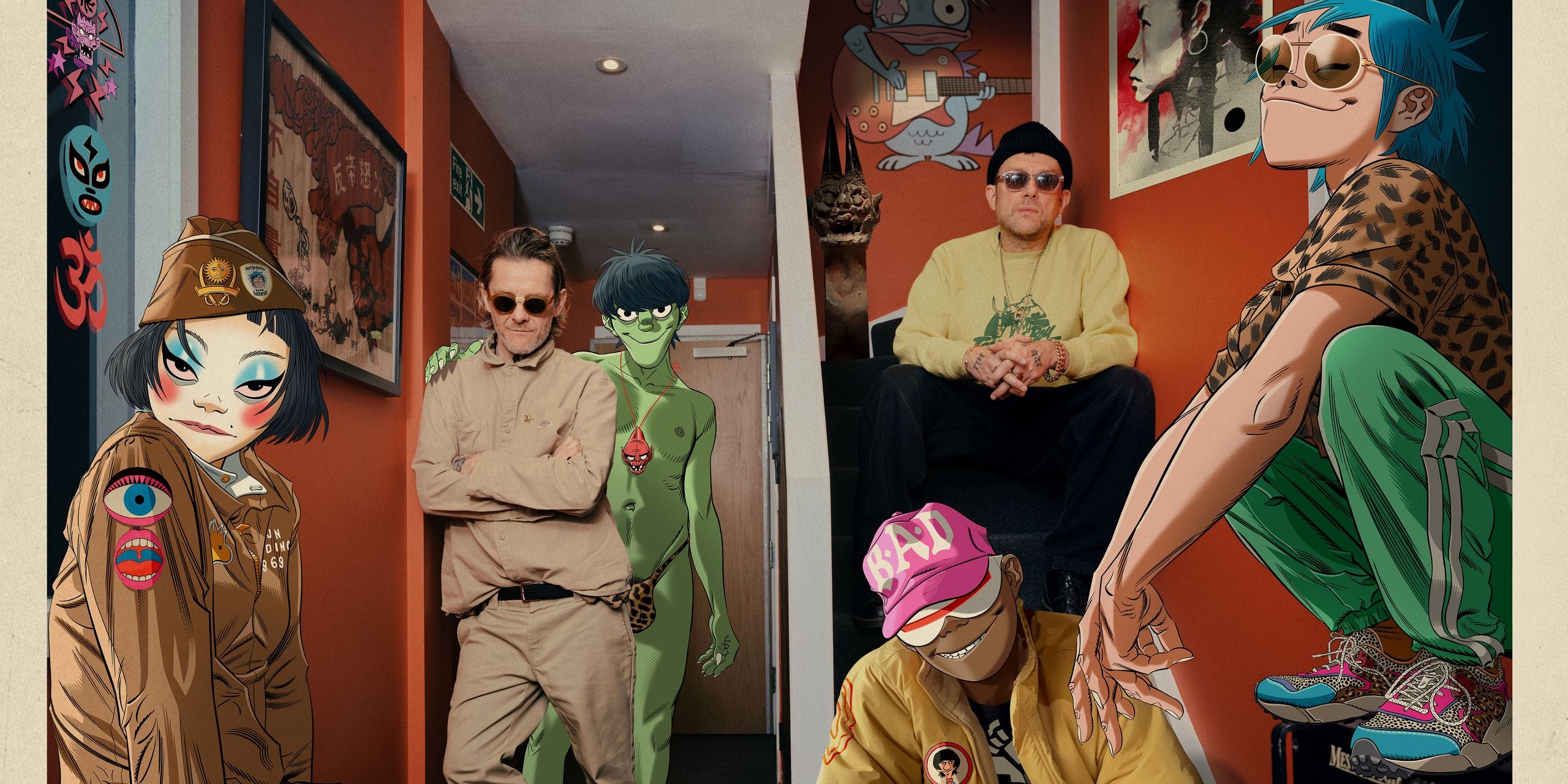
Damon Albarn, frontman of Blur & artist Jamie Hewlett somehow ended up as roommates in London one night, and as they’re watching MTV, they hate everything they see. It’s just a bunch of manufactured pop stars, & just all things superficial. Out of that frustration, they cook up this idea of a virtual cartoon band that doesn’t technically exist. Four animated characters (Noodles, Murdoc, Russel, & 2-D) who could say what real artists couldn’t and exist completely outside the rules of the music industry.
Each character developed with their own lore and story, running in conjunction with the music, and after the release of their self-titled debut, Demon Days was released on May 11, 2005, a year after I was born!
Why is it good?
So… what makes it a great album? In short, it’s: story, interpretability, visual identity, and architecture & Demon Days has all four of those.
It’s a concept album, which means every song is connected to tell basically one entire story or communicate a central theme. The creators described this album as a journey through the night, where every track is a confrontation with a different personal demon.
You are now entering the harmonic realm
Story:
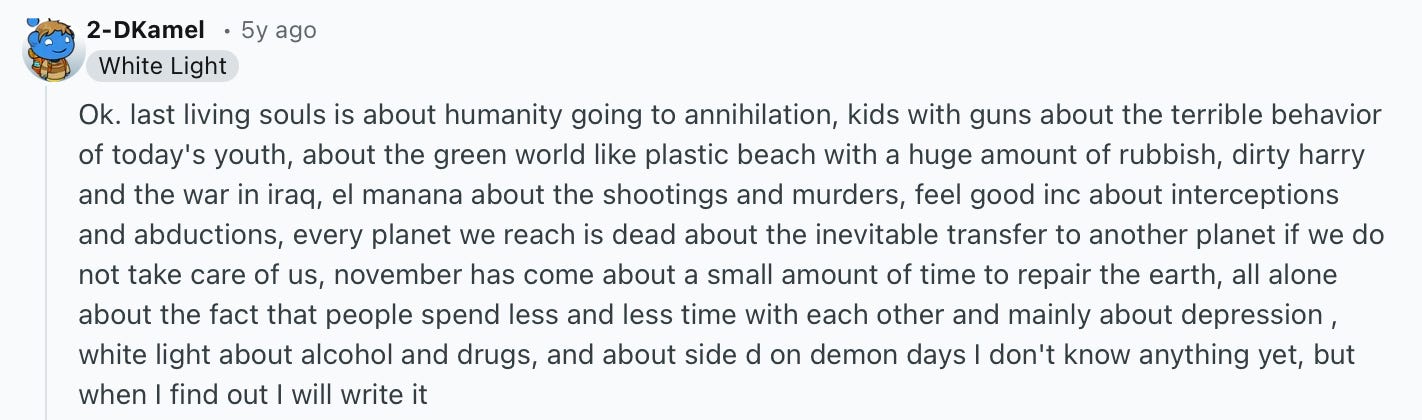
You begin the album in what feels like a weird, ominous fever dream with the first track, “Intro.” As you progress throughout the album, you get Last Living Souls about humanity going to annihilation, Kids with Guns about the terrible behavior of today's youth, Feel Good Inc about rebelling against big corporations, All Alone about the fact that people spend less and less time with each other, but mainly about depression and the more you move through it and by the time the title track closes everything out you’ve finished a pretty dark hard truth of songs.
Interpretability: Outside of facing personal demons and the darker truths of the world, just like any other great piece of music, you can take these songs and apply them to your own life in ways the creators probably never even intended. I remember the first time my cousin showed me Feel Good Inc. I was young, I didn’t really know what Gorillaz was, and I didn’t have any context for it. And I just remember sitting there watching that music video over and over again. Something about it made me uncomfortable, yet I couldn’t stop watching. I couldn’t stop listening to it. I loved it, and it unsettled me at the same time, and I had no idea why. I didn’t understand what the song was actually about. I wasn’t thinking about isolation or how the rappers in the music video symbolized the music industry, taunting and gloating at how they control the Gorillaz and constantly overworking them to the point that they barely get any sleep. I was just a kid, of course, but the feeling got through anyway, and I remember feeling super sad for 2-D. The music communicated something to me before I had the words for it, and now, after coming back to it as an adult, as someone who’s actually been through some tough things, the song and the entire album hit completely differently.
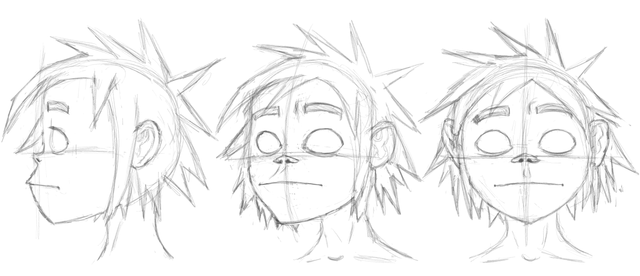
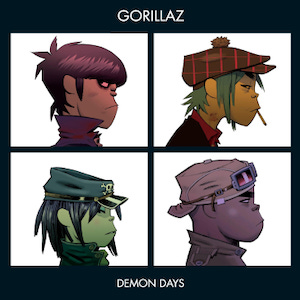
The visual identity: Gorillaz was doing something no one else was at the time. The cover of Demon Days is just the four virtual band members, close up portraits against a solid black background. Everything from the art direction to the music videos to the character lore is all pulling in the exact same direction. That is what a real visual identity looks like - not just having a cool art style, but having every single visual choice mean something and serve the world you’re building.
The architecture: The beat motifs & overall instrumental ideas that keep coming back and threading the entire project together. Damon brought in Danger Mouse to produce this album and that one decision changed everything. What Danger Mouse brought was this raw texture that runs through the entire record. The whole album feels like one continuous narrartive piece because it was and made to feel that way.
The Future of Gorillas
Now in a recent interview, Damon Albarn was asked about the future of Gorillaz, and he basically said they plan to pass it on to the next generation & hand the cartoon characters over to a younger team. I get it, the whole point of Gorillaz was always that the cartoon is bigger than the humans behind it - the concept can theoretically live forever, but just spent time explaining why Demon Days is one of their greatest projects and why I love it. The story, the world, & the architecture and every single one of those things came from the specific brains and the specific obsessions of Damon Albarn and Jamie Hewlett. You cannot pass that on. You can pass the characters but you cannot pass the genius behind it.
So I want to know what you actually think. Are the Gorillaz bigger than its creators? Or is it inseparable from them? Because I have my answer, but I genuinely want to hear yours.
Thank you so much for reading my yap! If you want to watch the lovely YouTube video paired with this Substack, you can find it below :D
3 Song Recs:
I Live With You by Grizzly Bear
Modern Guilt by Beck
Cold Shoulder by Adele
What I listened to as I wrote this:
Last Living Souls by Gorillaz
The Number Song by DJ Shadow
Feel Good Inc. by Gorillaz
Resources:
Demon Days - Gorillaz Darkest Album (Lyrical Analysis and Meaning Explained)
https://www.slideshare.net/slideshow/demon-days-gorillaz/63925334